THIS BLOGGER HAS MOVED!

THIS BLOGGER HAS MOVED!
I am now writing exclusively over at the Christians In Context blog. Click on this banner to be taken there!

Redeemer Church

Redeemer Church
Looking for a church in the Omaha area? Come check out ours on Sunday mornings at 11!

Tuesday, September 29, 2009

Book Review: Hollywood Worldviews by Brian Godawa

I love movies. They are part of the language of our culture and generation. I believe that many in my generation absorb their beliefs and worldview from the movies they watch without even knowing it. I also believe that our entertainment in general (but movies specifically) shape our values as a culture as much as it reflects our values as a culture.

This is why, if I were so gifted, I would be making movies today. Movies that put the themes of the Gospel, of fall and redemption, of substitutionary atonement, on the silver screen in a way that makes it real and palatable to the average viewer. And this is why I loved Hollywood Worldviews by Brian Godawa so much.

Godawa is a Christian in the industry, making (and thinking about) movies with just such a motivation in mind. Without endorsing all movies wholesale, Godawa makes an argument for the value of movies to instruct, inform, and simply reflect the God-given creativity in the creature and the beauty of creation around us. Speaking of finding the value in movies, Godawa says, "Because all truth is ultimately God's truth, we can find what we think is true in a movie and dissect what we think is false".

Godawa goes straight to the hot-button topic for the Christian concerning movies, addressing "Sex, Violence and Profanity" in Chapter 1. His key point about such issues is that "context makes all the difference between moral exhortation and immoral exploitation of sin". In following chapters he begins to address the Hollywood worldviews such as existentialism, postmodernism, and other worldviews. These chapters were some of the most personally enjoyable, as I saw many movies I've watched in a completely different light.

Even for those of you who don't spend much time talking or thinking about worldviews, this book has much to benefit from. In particular the first and last chapters lay out some excellent guidelines and principles for watching and engaging with Hollywood and it's culture. This book was well written, even better thought-out, and I endorse it to anyone who likes movies. I'm assuming that's all of you.

Tuesday, September 22, 2009

Win a FREE NLT Mosaic Bible!!!

Exciting day! For the first time on this blog, I get to give away something! Today is the release date of the New Living Translation Bible: Mosaic Edition. You can preview or buy your own copy over at Amazon.com.

Stay tuned for a review of Mosaic in the very near future, as well as a guest post from one of the contributors!

And now for the giveaway instructions: simply post a comment (or e-mail it to me, I must be able to contact you if you win) on why you think you should win the copy of Mosaic.

Also, double your chances of winning and head over to the Christians in Context blog where I am a contributor as well and make a submission on that blog's giveaway in the next couple of days.

Tuesday, September 15, 2009

Greg Koukl on Conversant Life

I heard a quote I really liked from Greg Koukl made during an interview on http://www.conversantlife.com/.
"Narrow-mindedness is different than having a narrow view. We have a narrow view. That is, we believe we are right in [our Christians convictions] and therefore other views are wrong. All of the claims of truth are narrow.

Narrow-mindedness does not have to do with the view, it has to do with the person. It's a vice of thinking. A narrow-minded person is a person who is stuck in his view and is not willing to consider alternate views. I have a narrow view, but I am certainly open to considering other people's points of view and dealing with the evidence for it."
Note his point that all claims of truth are narrow. That is, they narrow certain other claims of truth out. No one claim of truth can be truly all-inclusive, because it will, by definition, narrow out those claims of truth that are exclusive.

Wednesday, September 9, 2009

Book Review: Love Is an Orientation by Andrew Marin

Andrew Marin has written one of the most illuminating and challenging books of the year, pressing his finger in on a sore spot in the side of Christianity with Love Is an Orientation. The church's relationship with the gay/lesbian/bisexual/transgender community (or lack thereof) has been a black eye for us and a favorite straw man for anyone wanting to bash the church.

I found myself agreeing more often than not with Marin's approach and reasoning, attempting to "elevate the conversation" rather than cut it short. One insightful point was that both the GLBT and fundamentalist communities will often ask closed-ended questions in order to force you to simply "pick a side" in the fight. (Questions like: Do you think homosexuality is a sin? Do you think that someone can be gay and Christian? Are GLBT people going to hell? Hint: there are better answers than a simple "yes" or "no".)

While I agreed and resonated with his approach to love, accept, and build relationships with the GLBT community, there was one full chapter with which I could not agree. When it came time to finally address the passages in the Bible about homosexuality (or the Big 5 as he called them), he considered the particulars, interpreted them into an overarching principle, and then ignored the particulars. In this way, he never addressed the individual verses themselves, bypassing them in a sort of contextual paraphrase with the surrounding verses.

I do feel that Andrew Marin soft-pedalled more than necessary around the homosexuality as sin issue. Since I work in the travel industry, I spend a lot of time around hotel and airline employees where the GLBT percentage is higher than average. Yet I am baffled by the need to treat them any different than any of my other co-workers. I work with one guy who is living with his girlfriend. I work with another who is rumored to be having an affair. Yet I do not feel compelled to go all "fire and brimstone" on them about their sexual deviance. While I am not softening in my mind the fact that they are sinners and in practicing sin, that sin is peripheral when it comes to my relationship with and evangelism towards them. I love my co-workers, I care for them, I want them all to see the superiority and beauty of Jesus. I want them all to believe on Him for salvation.

While Marin (in my opinion) at times erred too far on the side of diplomacy, perhaps he is a product of fundamentalism erring too far in the opposite direction for far too long. This is an important work for the Christian church, not always for the answers he gives, but for the questions he raises and the dialogue he starts.

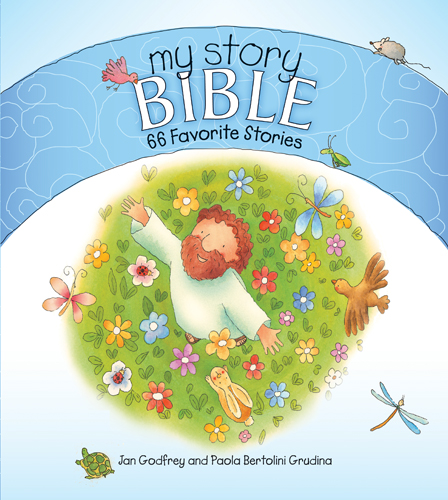
Book Review: My Story Bible

Now I know what you're thinking, this is not the standard fare for my blog. But I do have a six-month old now, and so my blogger book review program may feature the occasional children's book. As the resident artist in the Totten family, my wife also made some contributions to this post, so what follows is the first official Totten family post.

My Story Bible by Jan Godfrey and Paola Bertolini Grudina is a great introduction to the Bible for young children. I was very impressed with the hand-drawn pictures on every page that illustrate some of the most memorable stories in the Bible. I was surprised, however, to find how many of the biblical stories were witnessed by butterflies, ladybugs, bunnies, birds, and cats. I kid.

There are 66 stories in My Story Bible. However, before you think that there is one for every book in the Bible (there are 66 of those too), I must clarify that they picked 66 of the most dominant, important, and memorable stories from the Bible, not one from every book. Noticeably missing are stories from Leviticus, Numbers, and Deuteronomy. I said noticeable, not necessarily unfortunate. Also, missing is the account of Hosea and his prostitute-wife Gomer. All in all, good editorial decisions for a children's Bible.

All kidding aside, my wife and I are very pleased with My Story Bible and have already begun reading it to our daughter. She really likes the butterflies and bunnies.

Monday, September 7, 2009

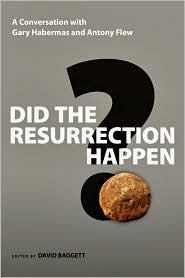
Book Review: Did the Resurrection Happen? by Gary Habermas and Antony Flew

Given the two names on the front of this book, I was initially intimidated at the prospect of picking it up for fear I would be subjected to a pedantic debate between two intellectuals using terms and ideas on par with their intelligence. To my surprise, this was not the case.

Did the Resurrection Happen? by Gary Habermas and Antony Flew read less like an advanced theological textbook and more like a conversation. This is, of course, because two-thirds of this book were originally conversations. The book is divided into three parts, the first of which was basically a transcript of a debate between Habermas and Flew that took place back in 2003 during an event held by the Veritas Forum. This section was an engaging read and altogether too short.

The second part was also a transcribed conversation between Habermas and Flew (long time friends) regarding Flew's journey to theism, an event that sent shock-waves through both sides of the atheism/theism debate. Through both of these sections I was pleasantly surprised to find the conversational style a very accessible read a la Lee Strobel (minus the hint of feigned scepticism).

If one section seemed cumbersome and out of place, it was the third. Written by the editor, David Baggett, it was actually longer than either of the first two sections. Unfortunately, it fell victim to the very intellectual inaccessibility who's absence made the first two sections so enjoyable.

While this book won't be convincing to the most hardline skeptics, Christians and the doubters and seekers of Flew's sort will find this a very accessable read.

Saturday, August 22, 2009

Book Review: The Lost Virtue of Happiness by J.P. Moreland and Klaus Issler

I was fully prepared to enjoy this book, having already enjoyed one by J.P. Moreland earlier this summer called Love Your God With All Your Mind. So if he can write such an excellent book on the role of the mind in the life of the Christian, why not on the role of the spiritual disciplines in the life of the Christian? After all, that is how The Lost Virtue of Happiness by Moreland and Issler was billed.

"Discovering the disciplines of the good life"
"A fresh look at the spiritual disciplines"

Alas, I was disappointed on two fronts. Unfortunately, the earlier book I'd read by J.P. Moreland was a factor in this book being a let-down. In at least two rather extensive portions (that I noticed), J.P. borrowed heavily and even quoted word for word sections from Love Your God With All Your Mind. This is not a grave offense, I've noticed other authors do it before. However, in this instance it felt forced and a little out of place because the sections did not seem to fit the expressed intent of the book.

Which brings me to my second critique. For a book supposedly dealing with spiritual disciplines, they were not the disciplines I was expecting. Instead of chapters devoted to prayer, fasting, and the study of the Scriptures, there were chapters like "Embracing the Hiddenness of God" and "Defeating Two Hardships of Life: Anxiety and Depression".

After I got over the initial disappointment of being misled by the packaging, I found the book somewhat insightful in finding happiness in the Christian life (I would recommend this book to any Christian dealing with depression).

I know that often the publishers have the final say on what is on the front and back cover. Unfortunately, if that was the case with this book, it made some truly engaging and helpful material feel like a "miss" for me.