THIS BLOGGER HAS MOVED!

THIS BLOGGER HAS MOVED!
I am now writing exclusively over at the Christians In Context blog. Click on this banner to be taken there!

Redeemer Church

Redeemer Church
Looking for a church in the Omaha area? Come check out ours on Sunday mornings at 11!

Thursday, December 24, 2009

Top 10 Books I Read In 2009

I know this is quite cliche', but it's the Christmas season and all of us slip into the cliche' at some point during December. So I'm going to use my pass on this one: the top ten books I read this year. You may notice that not all the books that make the list were published this year. This is because this is the first year I've been on a serious reading regimine, thus I had some catching up to do in books from past years as well.

Before we begin, I am greatly obliged to those publishers and bookstores who have made much of my reading possible this year through providing free materials for review. Notably, I must thank InterVarsity Press, NavPress Publishing Group, Thomas Nelson Publishers, Tyndale Publishing and the Westminster Bookstore.

10. Finally Alive - John Piper
A beautiful and much needed book for Christianity, John Piper deals thoroughly with the rebirth, regeneration, and new life of the Christian. It is exhaustive without being exhausting or intimidating (as Desiring God and some of his other works can be at times). A great place to start to understand the Reformed position on God's role in our salvation.

9. Tactics - Greg Koukl
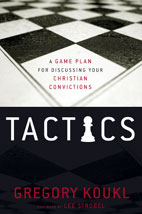
This may be the least well-known book on this list, but Greg Koukl (host of the weekly Stand To Reason radio program) has written the perfect handbook on apologetics. He is not answering specific challenges leveled at Christian apologists, rather his book addresses techniques (or tactics) for making a defense for the Christian faith in a way that is honest, charitable and winsome. This book is uniquely helpful.

8. Why We're Not Emergent (By Two Guys Who Should Be) - Kevin DeYoung and Ted Kluck
If there were two cultural movements that generated the most Christian books this year, I am guessing it would be the New Atheism (from without) and the Emergent church (from within . . . Sorta. Maybe. Even they would probably equivocate here). Why We're Not Emergent is a good introduction to the debate though it's obvious which camp they are coming from.

7. Hollywood Worldviews - Brian Godawa
As a Christian in the movie industry, Brian Godawa is uniquely positioned to write this book. Even for those of you who don't spend much time talking or thinking about worldviews, this book has much to benefit from. In particular the first and last chapters lay out some excellent guidelines and principles for watching and engaging with Hollywood and it's culture. This book was well written, even better thought-out, and I endorse it to anyone who likes movies. I'm assuming that's all of you.

6. Total Church - Tim Chester and Steve Timmis
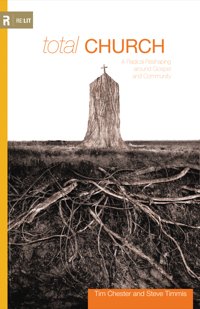
This book will not be for everyone, but for those in church ministry this is a must-read. While not a revolutionary book on how to "do church", it gives a wonderful picture of how a healthy church "does life together". (Shoot me for using those phrases) Do you believe church is simply meeting once a week? You must read this book. Do you believe it is something much more? You will love this book.

5. Hidden Worldviews - Steve Wilkens and Mark L. Sanford
In Hidden Worldviews, Authors Steve and Mark deal with what they call "lived worldviews". These lived worldviews include such ideas as individualism, consumerism, nationalism, moral relativism and salvation by therapy. Every chapter details both the truth or good as well as potential problems of each worldview before drawing a conclusion. In this manner, the authors present a very even-handed treatment of each idea without sounding alarmist or too "Chicken Little". A very refreshing read and quite unique in it's approach and subject matter.

4. The Reason For God - Timothy Keller
Dealing with some of the biggest and most common objections to Christianity, Tim Keller has written one of the best apologetic books for Christianity that I have ever read. So good, in fact, that I have not been able to keep it in my possession since reading it because I've been perpetually loaning it out.

3. Blue Like Jazz - Donald Miller
Yes, as I warned, this book is the best example of how behind I am on my reading. I'm sure this was on everyone else's list five years ago but better late than never I suppose. And I certainly see what all the hype was about. Don talks about his own spiritual journey in a very existential manner, but there is enough orthodoxy in here to keep even a doctrinal stickler as myself mollified.

2. When Helping Hurts - Steve Corbett and Brian Fikkert
Steve and Brian have written the best book I have ever read for the Christian and poverty relief. This book is full of insights from two guys that have seen it work on the ground level. Insights like: how poverty of all sorts is linked to man's fallenness, the different stages of poverty and the different ways they need to be addressed, and how we perpetuate instead of alleviate poverty by just throwing money at it. This book is greatly needed and will become more important in the coming years as celebrity poverty aid and social justice gospels grow in popularity.

1. Notes from the Tilt-A-Whirl - N.D. Wilson
I am well aware that my number one book is probably not on anyone else's list or even on their radar. And it is their loss. While not everyone liked this book as much as I did (Pastor Lee), no other book this year made me goose-bumpy or made me laugh and cry at the same time. His writing evokes emotion like the best fiction, scratches the brain like the best philosophy, and stirs a love for Creator and creation like the best theology. His thoughts come out jumbled and scatter-shot, but in the end he paints a beautiful word picture.

Tuesday, December 8, 2009

Book Review: God Is Great, God Is Good

The New Atheists have been getting a lot of attention lately; first from the general public because of their writings, and then from the Christian community because of the general public's interest. And just as the ideas of the Dawkins, Harris, Hitchens and Dennett have spawned several books, so the rebuttals of Christian academia have also been the fodder for many publications in the last year or so.

God Is Great, God Is Good is one of the finest examples of this mini-genre and it brings together some of the sharpest minds in Christian apologetics. Names like Michael Behe, Gary Habermas, and William Lane Craig offer their best defense for Christianity against the charges of the New Atheists. The diversity of authors in this book is perhaps both its greatest strength and its greatest weakness: strength because each author can focus on their respective field, and weakness because there is a noticeable absence of a clear train of thought from one chapter to the next.

While the flow of a single-author sort of book is missing, the structure of the book in the way the essays were grouped was quite appealing and seemed to address the general categories of challenges from the New Atheists well:
  1. God Is (God's existence)
  2. God Is Great (God's creative design)
  3. God Is Good (God's goodness)
  4. Why It Matters (A shift from theistic issues generally to Chrstianity specifically)
These authors certainly are nicer (and at times more academic) than the New Atheists have a reputation of being. Love them or hate them, however, the New Atheists seem to connect with something in their audience when they are at their most acerbic, sarcastic, and down-right nasty. There is a side of me that wishes that someone would sink to their level and deal with their charges in like form, but it is certainly to Christianity's credit that no one yet has done so.

All in all, God Is Great, God Is Good is a great book from many great writers addressing the challenges levelled by the New Atheists. While a few of these ideas and arguments may be over the heads of some, this book is a perfect introduction for someone who is ready to tackle the hot topics of the debate but is unfamiliar with the major players or where to get started.

This book was a free review copy provided by InterVarsity Press Academic.

Why Twilight Is So Bleeding Popular (Yes, pun intended)

Though I have not seen any of the Twilight movies yet, I found this article by John Granger to be completely fascinating and on point about popular entertainment.

Touchstone Archives: Mormon Vampires in the Garden of Eden:
"I suggest that the Twilight series is something for thoughtful people to be aware of and to think seriously about, first, because of its remarkable hold on the imagination of American readers and movie-goers, but second, and more important, because of the reason these books are so popular: They meet a spiritual need. Mircea Eliade, in his book The Sacred and the Profane, suggests that popular entertainment, especially imaginative literature and film, serves a religious or mythic function in a secular culture. When God is driven to the periphery of the public square, the human spiritual capacity longs for exercise, and it often finds it in the 'suspension of disbelief' and activity of the imagination that are available in novels and movies.

The books and films that satisfy this spiritual longing most profoundly are the ones that have religious content of some kind, sometimes any kind. Not just The Lord of the Rings and The Chronicles of Narnia but also Harry Potter and The Matrix contain symbolism and religious notes that resonate with readers and moviegoers.

People are drawn to, and many are consumed by, those books and movies that most engagingly and convincingly deliver or smuggle in this religious content and mythic meaning. Not surprisingly, though, this meaning cannot tear down or even challenge the golden calves of our modern moral landscape."

Thursday, November 19, 2009

Book Review: We Become What We Worship by G.K. Beale

I've had We Become What We Worship in my wish list for months now, so when the opportunity came to review it for free, I jumped at the chance. Unfortunately, there have not been many books that I was so predisposed to like that have been such a struggle for me to finish. Not because of poor writing or a disagreement with the author, but rather in part due to my own expectations, as the author's intent was to write "a biblical theology of idolatry". This is a well-written and thorough treatment of idolatry that is quite academic in nature.

This book grew out of a message G.K. Beale delivered entitled "What You Revere You Resemble, Either For Ruin or Restoration" and he has certainly done his research. The hangup of the book for the average reader is that he takes us step by step along the same journey of study with him which turns the book into a monster of biblical exegesis . Of course, the average reader was not Beale's audience to begin with, and the academic community stands only benefit from this biblical exegesis on idolatry (which, again, was his expressed intent).

I basically agreed with his premise two pages into the first chapter, but he spent a chapter each on building his case from the Old Testament, Gospels, Epistles, Revelation, and even the intertestamental/apocryphal books. Beale first began to formulate his thesis during an extensive study of Isaiah 6, thus his first chapter focuses solely there for his opening argument. The first 250 pages are spent building a textual argument for his ideas before finally getting to a very good (but all too short) 60 pages of application and conclusion.

While this book was well-researched and written, it will be too in-depth for the average reader and is best suited for pastors preaching on idolatry and the academic community. But if they ever come out with a Clif Notes version, I want to be at the top of the list.

This book was a free review copy provided by InterVarsity Press Academic.

Thursday, November 12, 2009

New Federal Trade Commission Guidelines

The Federal Trade Commission recently revised their guidelines that affect testimonial advertisements, bloggers and celebrity endorsements. "The revised Guides specify that while decisions will be reached on a case-by-case basis, the post of a blogger who receives cash or in-kind payment to review a product is considered an endorsement. Thus, bloggers who make an endorsement must disclose the material connections they share with the seller of the product or service." In the interest of full disclosure and in compliance with the new FTC guidelines, I feel compelled to share the following:
  1. All of the books prior to this post that I have reviewed have been given to me free of charge by the publishers for the sole purpose of a review. No expectation of a positive bias was communicated or implied by any of the publishers. In fact, a cursory reading of some of my reviews will show I don't shirk from a negative review.
  2. No payment or compensation has ever been made to me from the publishers beyond free review materials.

There, I feel better.

Sunday, November 8, 2009

Book Review: Hidden Worldviews by Wilkens and Sanford

Hidden Worldviews is not your average book addressing worldviews. There are no chapters on nihilism, existentialism, or Eastern monism (though a nod is made to The Universe Next Door, and James Sire even writes a blurb for the back of the book, calling Hidden Worldviews "an excellent compliment" to his own standard work).

Unlike most other writers addressing worldviews, authors Steve Wilkens and Mark L. Sanford deal with what they call "lived worldviews". These lived worldviews include such ideas as individualism, consumerism, nationalism, moral relativism and salvation by therapy. They are so called because "we are more likely to absorb them through cultural contact than adopt them through a rational evaluation of competing theories. These lived worldviews are popular philosophies of life that have few intellectual proponents but vast numbers of practitioners".

Because of the subtle nature of these ideas, Wilkens and Sanford suggest that there is a greater risk of such ideas being smuggled into and blended with Christianity almost unknowingly. Indeed, to the extent that the traditional worldviews pose a challenge externally to Christianity, these worldviews seem to be a challenge within Christianity as well as without.

Every chapter deals with a specific lived worldview and details both the truth or good as well as potential problems of each worldview before drawing a conclusion. In this manner, the authors present a very even-handed treatment of each idea without sounding alarmist or too "Chicken Little".

If I have had one frustration that keeps popping up during this first year of setting a significant reading goal for myself, it has been that, as the writer of Ecclesiastes would say, "there is nothing new under the sun". However, this book was an exception, a very refreshing read and quite unique in it's approach and subject matter. Overall, it was a very readable and enjoyable book, and one of my top ten for the year!

This book was a free review copy given by InterVarsity Press Academic.

Tuesday, November 3, 2009

Book Review: Respectables Sins by Jerry Bridges

Jerry Bridges wrote one of the best books I've ever read on Christian sanctification in Pursuit of Holiness. But if Pursuit of Holiness is Sanctification 101, then Respectable Sins is Sanctification 301. While the former book focused on the broader subject of sanctification and dealt with the more common besetting sins, the latter focuses on the more subtle sins that often go unaddressed.

Before dealing with specific areas of sin, the opening chapters of Respectable Sins set the necessary foundation by addressing sin in general and the power of the Holy Spirit to overcome it. In this way, the first few chapters read like a concise summary of Pursuit of Holiness. The remainder of the book addresses issues like anxiety, unthankfulness, selfishness, and judgmentalism. Each of these chapters follows a similar formula, defining and exposing the sin before giving the reader practical steps of action against it.

The reader must be careful to read this book without any legalism/judgmentalism. Most readers will either be tempted as they read to think "This guy is nuts and completely overboard" or "Ooooh, I can think of some people that need to read this". I confess both thoughts while I read. As my pastor has said, each Christian has areas they struggle with where they need to be legalistic with themselves (meaning there are certain things an individual Christian cannot let themselves do that others may do). So there are points when Bridges shares his own personal areas of legalism, but we must understand it in a context of wisdom for him.

This book is not for everyone. A non-Christian may read it and think Christians are all hyper-paranoid moralists. A legalist may read it and project all their judgments on the Christians around them. But for the Christian using this book with sensitivity and wisdom, this is a wonderful book on many of Christianity's blind spots when it comes to pursuing Christ-likeness.